

Tesla Cybertruck Audio Upgrade Guide

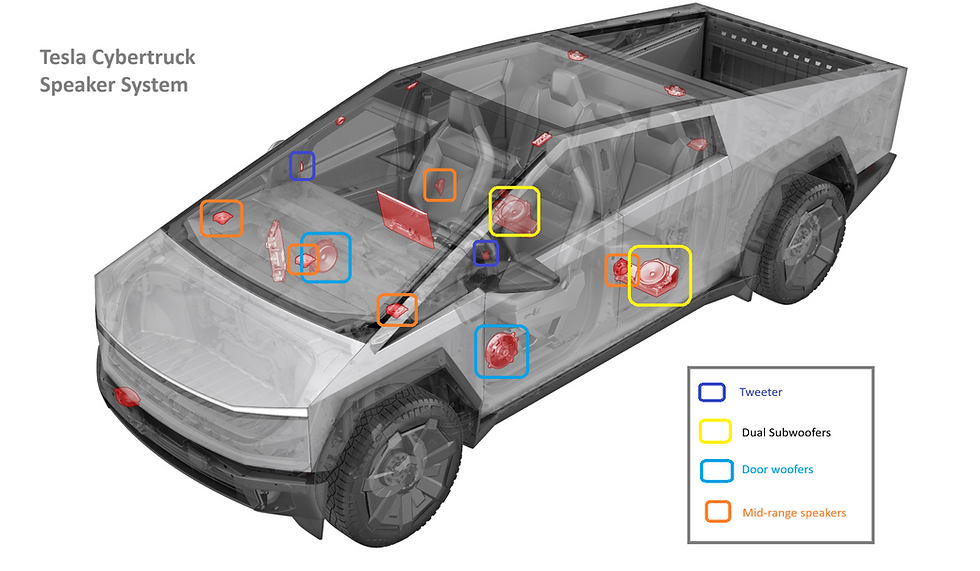
Cybertruck makes people overconfident.
Maybe it is the shape. Maybe it is the stainless steel. Maybe people look at it and decide normal rules have been cancelled. I do not know. But sound does not care about attitude. A connector still has to match. A speaker still has to sit where it belongs.
That is where a lot of Cybertruck upgrade conversations should start. Not with volume. Not with the biggest package. With fitment.
Quick answer: Cybertruck speaker upgrades should use vehicle-specific fitment. Light Harmonic offers factory-location speaker paths for selected configurations, including Long Range and AWD/Cyberbeast packages. Confirm the exact truck and factory speaker layout before installation.
Cybertruck is not a generic sound project
This vehicle has its own cabin, its own packaging, and its own way of making simple things feel slightly strange. That is not bad. It just means guessing is expensive.
A generic approach usually starts with the question, what can we fit in here? A Tesla-specific approach starts with a different question: what does the vehicle already give us, and how do we improve it without turning the install into a construction site?
That difference matters. Especially in a new platform.
Why there is no single Cybertruck amplifier upgrade yet
Cybertruck is also a 48V vehicle. Tesla's owner manual says the truck uses a 48V lithium-ion low-voltage battery, and Tesla's service manual describes the electronics as a 48V mid-voltage architecture designed for efficiency. That matters for sound work, but not in the simple way people expect.
On older Tesla platforms, an amplifier upgrade can often be treated as one central box in the signal chain. Cybertruck is not like that. Based on our own teardown, the amplifier work is spread across six locations. There is no clean single amplifier module we can remove, replace, and call it done.
That is why our Cybertruck line is speaker-first for now. We can improve the factory speaker locations, and that is the part we can do cleanly. A full amplifier replacement would mean chasing a distributed system through the truck, like trying to tune one piano by reaching into six different rooms.
The 48V architecture is efficient. It also changes the upgrade path. We may build a focused amplifier solution for the subwoofer side later, because bass control is where a targeted power upgrade could make sense. But we are not going to sell a universal Cybertruck TAS amplifier until the engineering is clean enough to stand behind.
Product paths
Long Range
For the listed Long Range configuration, Cybertruck Long Range 7 is the focused speaker upgrade path. It is meant for owners who want a cleaner factory-location move rather than a full-system leap.
AWD and Cyberbeast
For listed AWD and Cyberbeast vehicles with the supported factory speaker layout, Cybertruck AWD Cyberbeast Ultimate 11 is the larger package.
The names are long because the fitment matters. Long names are annoying. Wrong parts are worse.
Why factory-location work matters here
Cybertruck invites improvisation. That is part of its personality. But speaker installation usually rewards the opposite.
Factory-location design keeps the job understandable. It gives you a way to verify the speaker path before trim is fully apart. It also helps preserve a cleaner upgrade path, and where applicable, a more reversible one.
The point is not to make the install feel heroic. Heroic installs are overrated. The best installs are a little uneventful. You remove what needs to be removed, check the connector, place the part, test the sound, and put the car back together like nothing dramatic happened.
What the sound should do
The goal is not just louder sound. Louder is easy. Useful is harder.
In a Cybertruck cabin, the changes worth chasing are controlled bass, cleaner vocals, and more open upper detail. You want the front stage to feel less trapped. You want bass notes to have a beginning and an end. You want the tweeter detail to appear without turning the whole top end into ice.
Tesla cabins are quiet enough that small changes show up. That is why speaker location, material, and fitment matter. A quiet room does not forgive sloppy work.
Materials and design choices
Many Light Harmonic Gen 3 speaker designs use neodymium magnets and carbon-fiber materials. Those choices are not there so a product page can wear fancy clothes.
A speaker in a vehicle has limited space, heat, vibration, and a cabin that keeps arguing with it. Material stiffness, motor strength, and controlled movement matter. You do not hear the word neodymium. You hear whether the driver keeps its composure when the music gets busy.
What to confirm before ordering
Vehicle configuration: Long Range, AWD, or Cyberbeast.
Factory speaker layout and speaker count.
The exact Light Harmonic product page and SKU.
Photos of connector and speaker locations if fitment is unclear.
Whether you are comfortable removing trim and checking parts carefully.
If something looks close but not right, stop. Close is not a fitment category. Send photos to support before forcing anything.
Installation confidence
Speaker work can be DIY-friendly when the truck matches the product listing and the installer is careful. But DIY-friendly does not mean careless. Plastic clips still break. Connectors still need respect. Your future self will thank you for taking photos before disconnecting things.
Use installation videos to preview the kind of work involved. If you are comparing the Cybertruck path with other Tesla vehicles, the Tesla audio upgrade guide gives the broader system view.
Common questions
Is this plug and play?
The listed products are built around factory-location installation where the supported configuration matches. Always verify the product page before starting.
Can I use the same logic as Model Y or Model 3?
No. Cybertruck should be treated as its own platform. Some sound-system principles carry over. Fitment assumptions do not.
Should I force a part if it almost fits?
No. Stop and send photos. A small mismatch is easier to solve before trim, connectors, or brackets are damaged.
Where should I start?
Start by identifying the truck configuration. Then choose either the Long Range 7 path or the AWD/Cyberbeast Ultimate 11 path if your factory layout matches.
Cybertruck is already loud enough visually. The sound does not need drama.


Comments